The Belonging Gap: Why Connection Is Becoming the Core Leadership Skill
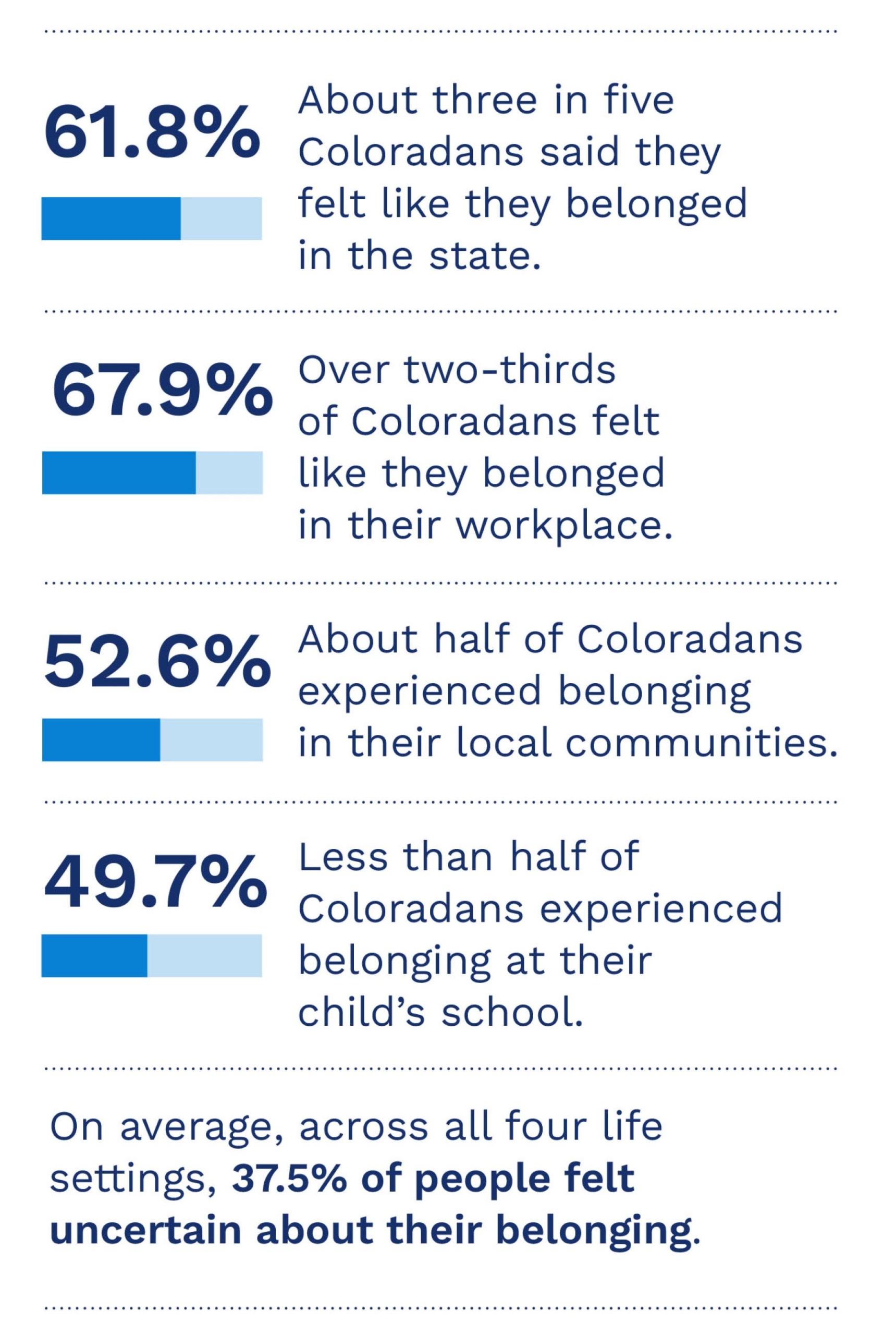
“Increasing belonging across all settings is needed.” Colorado Health Institute: https://www.coloradohealthinstitute.org/research/colorado-belonging-barometer
In every program we run—from Academy to Mastermind to Elevate—one truth consistently emerges: leaders today are struggling more with connection than with competence.
Across Colorado’s mountain and rural communities, leaders are managing more responsibilities with fewer resources. Many describe living in a constant state of time poverty—the chronic sense of having too much to do and not enough time to do it. Research out of UCLA calls time poverty one of today’s most pervasive emotional burdens, leaving people feeling depleted, disconnected, and less capable of meaningful engagement.
When leaders are overextended, the first thing to erode isn’t productivity. It’s belonging.
Why Belonging Matters More Than Ever
Decades of social science research across numerous higher education institutions and leadership scholars—including Colorado State University (CSU), the University of Colorado system, Colorado Mesa University, and statewide partners such as CiviCO and The Civic Canopy—reinforce a central truth: humans naturally connect. National experts like Brené Brown, More in Common, and practitioners at the Harvard Negotiation Project and Stanford’s Center for Social Innovation further demonstrate how belonging, trust-building, and bridging across differences are foundational to resilient communities. This body of knowledge is echoed by the Bridging Differences initiative at UC Berkeley’s Greater Good Science Center, alongside research from Robert Putnam (Bowling Alone), David Brooks and the Aspen Institute’s Weave Project, and the CSU’s Center for Public Deliberation’s work on deliberative democracy. Together, these institutions and scholars confirm that belonging is not a “soft” leadership skill; it is a performance driver, a conflict prevention strategy, and the foundation of psychological safety, innovation, trust, and shared civic life.
Yet paradoxically, leaders today have less time, attention, and emotional bandwidth to nurture the very relationships that make teams and communities strong. The widening “Belonging Gap” becomes visible in everyday interactions—both subtle and significant—when leaders no longer intentionally cultivate connection.
You can see this gap when:
- Teams shift from relationship-building to pure transaction, focusing only on tasks
- Meetings turn into status updates rather than meaningful conversations
- Hybrid and remote schedules reduce informal, trust-building moments
- People begin to feel isolated inside their roles, unsure where they fit
- Communities and workplaces experience greater polarization and misunderstanding
- Individuals feel less seen, valued, or understood by colleagues or leaders
- Emotional cues go unnoticed because everyone is moving too fast
- Conflicts linger because there’s no time to repair, clarify, or reconnect
- New staff struggle to integrate with fewer natural touchpoints
- People hesitate to ask for help, fearing they’ll burden others
- Trust erodes when interactions become infrequent or purely functional
- Creativity and idea-sharing slow as psychological safety weakens
- More conversations shift to email or text, reducing tone and nuance
- People seem more guarded, impatient, or easily overwhelmed
- Leaders feel pressure to perform rather than authentically connect
Belonging has become the core competency of modern leadership—not because it’s trendy, but because it determines whether people can do good work together in an era of pressure and distraction.
RFL’s Commitment: Leadership Is a Contact Sport
At Roaring Fork Leadership (RFL), we’ve intentionally designed our programs and events to counter the belonging deficit.
Meaningful leadership growth cannot happen in isolation or in a purely digital environment.
It happens in community, through real conversations, shared vulnerability, constructive tension, and learning across differences.
That’s why RFL emphasizes:
- In-person sessions where relationships form organically
- Circle-based discussions that build trust and voice
- Civic Impact Projects that require cross-sector collaboration
- Experiential facilitation that helps participants bridge perspectives
- Reflection practices that strengthen empathy and emotional regulation
Leadership effectiveness is no longer just about knowledge.
It’s about the ability to build bridges—between people, sectors, experiences, and ideas.
Our Work with Belonging Colorado
This past year, RFL deepened this commitment by participating in the Belonging Colorado Leadership Network Community of Practice (CoP)—a statewide effort to strengthen belonging and bridging across communities.
In the December CoP session, leaders explored:
- How bridging expands compassion
- Why humans are biologically designed for connection
- The interplay between belonging, character development, and community health
- Practical bridging skills that can be applied in leadership and civic projects
The message from the session was clear, highlighting what we learned:
“Belonging isn’t accidental. It’s something we build, moment by moment.”
A Leadership Invitation: Practice One Act of Belonging This Month
In the spirit of bridging, connection, and community, we invite our RFL friends and community to practice one intentional act of belonging in the next two weeks.
Here are a few accessible examples:
A Few Accessible Ways to Practice Belonging This Month
Small, intentional acts build belonging and strengthen trust and connection. Here are a few ways leaders can put this into practice—each simple, human, and powerful when repeated over time.
- Make time for a 10-minute “human check-in” before diving into the task list
What it means: Starting meetings or an interaction with a friend by acknowledging the people in the room, not just the work, creates rapport and psychological safety.
How to do it:
-
- Ask: “What’s one word that describes how you’re arriving today?”
- Invite a quick share: “What’s something you’re proud of from this week?”
- Use a simple prompt: “What’s fueling you? What’s draining you?”
Why it works: It signals that people matter more than agenda items—and that emotional context is part of the work environment, not separate from it.
- Invite someone outside your normal circle to coffee or conversation
What it means: Bridging requires intentionally connecting with people whose roles, perspectives, or lived experiences differ from your own.
How to do it:
-
- Invite someone you pass in the hallway but never really talk to
- Reach out to a leader in another sector or department
- Ask a simple opener: “I’d love to learn more about what you’re working on right now.”
Why it works:: These small bridges broaden our networks, reduce assumptions, and create understanding across silos—something our region deeply needs.
- Offer appreciation to a colleague whose work often goes unseen
What it means: Belonging grows when people feel recognized, especially when people overlook or take their contributions for granted.
How to do it:
-
- Thank someone who creates stability behind the scenes
- Call out a quiet strength: “I noticed how you handled that conversation with care…”
- Offer specific acknowledgment instead of generic praise
Why it works: Recognition fuels motivation, strengthens trust, and can shift an entire team culture when practiced consistently.
- Ask a curious, bridge-building question in a tense or polarized situation
What it means: Rather than arguing positions, bridging begins with curiosity—creating space to understand before trying to persuade.
How to do it: Try questions like:
-
- “Can you share more about what’s important to you in this?”
- “What’s the concern underneath that viewpoint?”
- “Where do you think we might have shared goals?”
Why it works: Curiosity disrupts defensiveness and invites dialogue, turning tension into an opportunity for connection.
- Reconnect with an alum or cohort member you haven’t talked to in a while
What it means: Relationships don’t maintain themselves—they require intentional tending, especially across time and distance.
How to do it:
-
- Send a quick message: “You came to mind today—how are you?”
- Share a resource, article, or update that reminded you of them
- Invite them to coffee or an upcoming RFL event
Why it works: Reactivating dormant connections strengthens the larger leadership ecosystem and reinforces the community of practice RFL works to build.
- Extend support to someone navigating a difficult season
What it means: Belonging deepens when we show up for people during vulnerable times—not by fixing, but by being present.
How to do it:
-
- Offer to lighten a task load
- Send a supportive note or meal
- Simply say: “I’m here, and you’re not alone.”
- Avoid assumptions; ask: “What would feel most supportive right now?”
Why it works: Empathy and presence build the kind of relational capital that allows teams and communities to weather challenges together.
These simple acts counter the effects of time poverty and reorient us back to what truly fuels strong leadership: connection, compassion, and community.
Why This Matters for Our Region
Belonging is not only a leadership skill—it is a community asset and a cornerstone of resilience. As our region navigates workforce shortages, generational divides, shifts in the local economy, and the rapid pace of change, the ability to build strong relationships across differences becomes essential.
The future of leadership in the Roaring Fork and Colorado River Valleys will be shaped not just by what we know, but by how well we relate, bridge, collaborate, and cultivate belonging—in workplaces, in neighborhoods, and across the civic systems that hold us together.
At RFL, we remain deeply committed to developing leaders who can do exactly that. Leaders who listen. Leaders who connect. Leaders who build trust and strengthen civic capacity. Leaders who elevate others, face complexity with courage, and help communities move forward—together.
Practice Leadership With Us
Belonging grows through intentional, everyday actions. If you feel called to strengthen your leadership practice, deepen your capacity to bridge differences, or engage more fully in building a connected and resilient region, we invite you to stay close to RFL:
- Explore our programs, workshops, and leadership offerings
- Learn how to become involved in civic impact work
- Access tools, stories, and resources that support your leadership journey
- Connect with a community of leaders committed to making a positive difference
Visit us at www.rfleadership.org
Reach out—we’d love to hear what belonging and leadership look like in your world.
Together, we can continue to cultivate a region where people feel seen, valued, and connected—and where leadership is not a title, but a daily practice that strengthens our communities.
Let’s lead with belonging.
#BetterLeadersBetterCommunities