
Listening Intelligence: The Leadership Skill Hiding in Plain Sight
RFL Academy Welcomed Dave Momper from Thrival Concepts on February 6, 2026 at the Basalt Regional Library.

Pictured: Steve Vanderleest, Andrea Palm-Porter, Dave Momper
If leadership is influence, then listening is its foundation.
This month, RFL Academy participants spent the day with Dave Momper, diving into the science and practice of Listening Intelligence, a powerful framework that expands how leaders understand communication, conflict, and collaboration.
At first glance, listening may seem simple. We do it every day. But as participants quickly discovered, hearing and listening are not the same thing.
Listening Intelligence challenges the assumption that communication breakdowns are about intent. More often, they’re about filters — what we are naturally listening to and for, and what we unintentionally tune out.
Listening Is Not One-Size-Fits-All
Through the ECHO Listening Profile, participants explored four listening preferences:
- Connective – listening for people and impact
- Reflective – listening for personal relevance and experience
- Analytical – listening for facts, accuracy, and data
- Conceptual – listening for ideas, patterns, and possibilities
There is no “best” listening style. Each brings value. Each also carries blind spots.
As Dave emphasized, listening is not a personality trait — it’s a habit. And habits can shift.
When leaders understand their listening defaults, they gain the ability to:
- Adapt in real time
- Reduce unnecessary conflict
- Increase clarity and trust
- Stay in dialogue when perspectives diverge
Why This Matters for Civic Leadership
RFL Academy is not just about personal growth it’s about strengthening our communities.
Complex community challenges require collaboration across sectors, lived experiences, and belief systems. That collaboration breaks down quickly when leaders assume others “aren’t listening” when in reality, they are listening differently.
Listening Intelligence gives leaders a shared language to navigate those moments.
- Instead of: “They just don’t get it.”
- It becomes: “They’re listening for something I’m not emphasizing.”
That shift is subtle and transformational.
Bridging Through Listening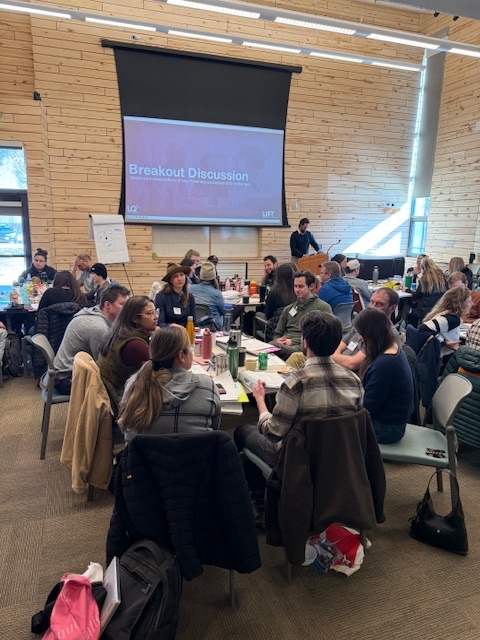
At RFL, we speak often about bridging and belonging staying connected across difference.
Bridging is not about agreement. It’s about staying present when it would be easier to withdraw, defend, or dominate.
Listening Intelligence strengthens bridging by helping leaders:
- Recognize their cognitive filters
- Notice when they’re listening to respond instead of understand
- Invite quieter voices into the conversation
- Translate across thinking styles
In Civic Impact Project teams, this awareness is already proving valuable. Teams are identifying where they over-index on ideas but skip reflection, or where they prioritize harmony but avoid hard data. Awareness is allowing them to adjust intentionally.
A Leadership Practice, Not a One-Day Lesson
One of the most powerful takeaways from the session was this: Listening is a leadership choice.
Participants left with practical commitments:
- Pause before responding
- Ask clarifying questions
- Listen for what feels least comfortable
- Adapt communication to match the listener
In a world that rewards quick answers and louder voices, Listening Intelligence offers something different — disciplined attention.
We are grateful to Dave Momper for guiding this deep and practical exploration. His work reminds us that leadership does not begin with speaking. It begins with understanding.
Because better listening doesn’t just improve meetings.
It strengthens teams.
It builds trust.
It increases civic capacity.
And ultimately it helps create better leaders for better communities.